Zhejiang Rongcai Machinery Co., Ltd

Comparison

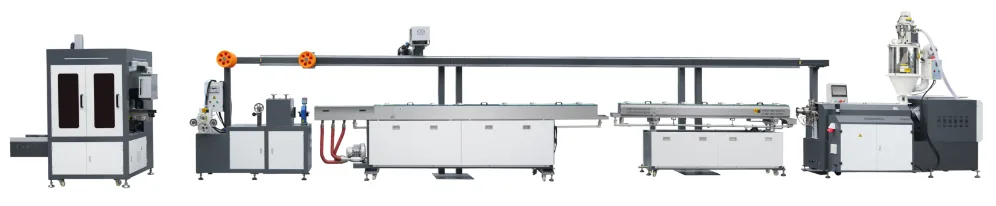
High-Speed vs Standard Filament Extrusion Line

This page compares only the configuration difference Rongcai has documented. No ranking or best-choice claim is made.

Comparison table

Documented configuration difference

Configuration itemRC-50 high-speed lineRC-45 standard-speed line
Process chainFeeding, extrusion, cooling, diameter control, traction, automatic windingFeeding, extrusion, cooling, diameter control, traction, automatic winding
Applicable materialsPETG, ABS, PLA, PLA+, etc.PETG, ABS, PLA, PLA+, etc.
Filament diameter1.75 mm ±0.03 mm (Accept Customized)1.75 mm ±0.03 mm (Accept Customized)
Extrusion output≤37 kg/h, adjustable≤25 kg/h, adjustable
Screw and temperature controlSingle screw 30:1 L/D, 6-stage independent PIDSingle screw 30:1 L/D, 6-stage independent PID
Traction and winding speedUp to 200 m/minUp to 120 m/min
Cooling water tank3+3+6 segmented water tank (Accept Customized)4+4 / 4+3 segmented water tank,optional (Accept Customized)
Diameter detectionDual-axis laser, ±0.001 mmDual-axis laser, ±0.001 mm
Installed power69.4 kW for the specified configuration69.4 kW for the specified configuration
Spool handlingAutomatic winding with tape fixingAutomatic winding with tape fixing or threading hole

Values shown as to be confirmed are closed with Rongcai engineering for each project. The values documented for the high-speed configuration are not assumed to apply to the standard line.

Operating conditions

Operating conditions at the installation site

Both lines are specified with the same ambient limits and the same utility requirements. The installation length is the figure that differs between the RC-45 and the RC-50.

Installation dimensions

RC-50 high-speed line
21,000 mm (L) × 1,420 mm (W) × 2,750 mm (H)
RC-45 standard-speed line
16,000 mm (L) × 1,420 mm (W) × 2,750 mm (H)

Total weight

RC-50 high-speed line
≤ 6,500 kg
RC-45 standard-speed line
≤ 6,500 kg

Spool storage capacity

RC-50 high-speed line
20+
RC-45 standard-speed line
20+

Operating temperature and humidity

RC-50 high-speed line
≤ 50 °C, ≤ 95% RH
RC-45 standard-speed line
≤ 50 °C, ≤ 95% RH

Power supply

RC-50 high-speed line
380 V, four-wire supply, max ≈ 69 kW
RC-45 standard-speed line
380 V, four-wire supply, max ≈ 69 kW

Control wires and cables

RC-50 high-speed line
Power supply to the equipment is the customer's responsibility
RC-45 standard-speed line
Power supply to the equipment is the customer's responsibility

Cooling water hoses and pipes

RC-50 high-speed line
Water supply provided by the customer
RC-45 standard-speed line
Water supply provided by the customer

Air supply

RC-50 high-speed line
200 L/min, ≥ 0.5 MPa
RC-45 standard-speed line
200 L/min, ≥ 0.5 MPa

Figures follow the RC-45 and RC-50 operating-condition tables. Site-specific utility connections are confirmed during project review.

Selection factors

Factors that decide between the two

  • Required extrusion output against the production hours available per day
  • Filament diameter and tolerance the market you supply requires
  • Spool core and maximum wound diameter you pack and ship
  • Floor space available for cooling and traction sections
  • Level of automation the shift pattern can support
  • Power supply and utilities at the installation site

FAQ

Comparison questions

What is the production capacity of a filament extrusion line?

Capacity is stated as extrusion output, not as a guaranteed finished-spool figure. For the documented high-speed configuration the extrusion output is up to 37 kg/h and is adjustable. Real throughput in service also depends on material, spool changeover and the shift pattern, so the figure is agreed with your own production target.

How is filament diameter controlled during production?

Diameter is measured in line with a dual-axis laser gauge at an accuracy of ±0.001 mm, so the operator sees the reading while the run is in progress. Extrusion temperature, screw speed, cooling conditions and traction speed are the process variables used to correct drift.

What does extrusion output mean on these lines?

Extrusion output is the amount of material the extruder processes per hour. It is not the same as the packed weight of finished spools, because winding, spool changeover and downstream handling also affect the final usable output.

How does automatic filament winding work?

At the end of the line the winding station takes the finished filament and spools it under controlled tension. When the spool is full, the machine finishes the cycle and secures the filament end so the spool can be removed, packed or stacked without manual taping.

Next step

Related products

RC-50 High-Speed 3D Filament Extrusion Line filament extrusion line

High-Speed

RC-50 High-Speed 3D Filament Extrusion Line

The RC-50 High-Speed 3D Filament Extrusion Line is a fully servo-controlled 3D printer filament production line designed to process materials such as PETG, ABS, PLA and PLA+ pellets into wound filament spools. It combines a 30:1 single-screw extruder with in-line laser diameter measurement, servo traction and automatic winding to support integrated filament production with reduced manual spool handling.

RC-45 Standard-Speed 3D Filament Extrusion Line

Standard-Speed

RC-45 Standard-Speed 3D Filament Extrusion Line

The RC-45 Standard-Speed 3D Filament Extrusion Line is a 3D printer filament production line for materials such as PLA, PLA+, PETG and ABS. It integrates extrusion, cooling, in-line diameter measurement, traction and automatic winding, with configuration options to match production targets, filament diameter and spool requirements.

Tell us your filament production requirement

Share the material, filament diameter, target output and spool specification. Rongcai reviews the configuration and prepares a quotation.