The RC-50 High-Speed 3D Filament Extrusion Line is a fully servo-controlled 3D printer filament production line designed to process materials such as PETG, ABS, PLA and PLA+ pellets into wound filament spools. It combines a 30:1 single-screw extruder with in-line laser diameter measurement, servo traction and automatic winding to support integrated filament production with reduced manual spool handling.
Servo traction and automatic winding replace manual spool handling
In-line laser diameter measurement with live diameter feedback
Six-stage independent PID temperature control
Built as one integrated line from feeding to wound spool
The RC-50 is a high-speed 3D filament extrusion line that integrates pellet melting, filament shaping, cooling, in-line laser diameter measurement, servo traction and automatic winding into a connected production process.
The line combines a 50-type single-screw extruder with a compatible automatic filament winding machine, linked through PLC-based control. It is configured for 1.75 mm filament with a specified diameter tolerance of ±0.03 mm, with adjustable extrusion output of up to 37 kg/h. Materials such as PLA, PLA+, PETG and ABS can be considered according to the confirmed process configuration.
Complete line: standard winder, up-spooling and traction groups, drying unit, water tanks, storage rack and the RC-50 extruder.
Main equipment specifications
Equipment name
3D Printing Filament Extrusion and Winding Automatic Production Line (RC-50 Tape Fixing Type)
Working principle
Raw material → vacuum feeding → heated extrusion → hot water tank → cold water tank → pulling → winding → finished product
Description
Raw material
PETG, ABS, PLA, PLA+, etc.
Production capacity
≤ 37 kg/h
3D filament diameter
1.75 mm (accept customer customized)
3D filament accuracy
± 0.03 mm
Extrusion speed
≤ 200 m/min
Spool storage capacity
20+
Operating conditions
Installation dimensions / weight
21,000 mm (L) × 1,420 mm (W) × 2,750 mm (H), total weight ≤ 6,500 kg
Operating temperature / humidity
≤ 50 °C, ≤ 95% RH
Power
380 V, four line, max 69.4 kW
Control wires / cables
Power supply to the equipment is the user's responsibility
Cooling water hoses / pipes
Water supply provided by the customer
Air supply
200 L/min, ≥ 0.5 MPa
Spool requirements
Suitable for processing paper spools, plastic spools, etc.
Supporting equipment
Screw-type air compressor
Key Purchasing Information
📦
Minimum Order Quantity
1 Unit
Low MOQ for B2B buyers
📅
Lead Time
≤ 65 Working Days
After receipt of deposit
🔧
Installation & Commissioning
Available
Overseas on-site service available; additional charges apply
🛡️
Warranty
1 Year
Factory warranty, subject to terms and exclusions
Line layout
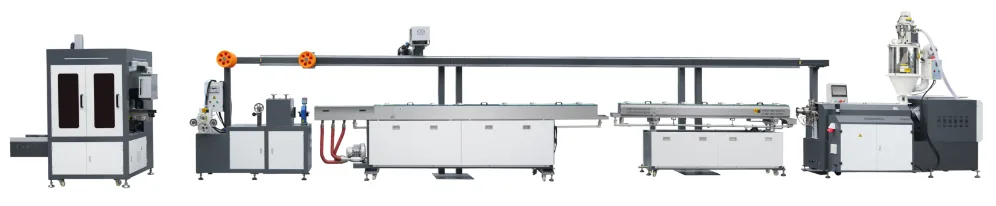
The layout drawing shows an overall line length of 15,455 mm in a straight run: the standard winder, up-spooling group, tractor and drying unit at the winding end, then the cold-water tank group, the intermediate hot-water tank group and the hot-water tank group, with the RC-50 extruder at the feed end. All units are floor-standing and connect to the extruder, hot-water tanks, main cold-water tank and tractor without additional conveyors.
Line layout drawing (top and side views) with the RC-50 extruder, tank groups and storage rack dimensioned.
Extrusion system
A single screw with a 30:1 length-to-diameter ratio and wear-resistant nitriding treatment melts and meters the material; screw speed reaches 200 r/min through variable-frequency or servo adjustment. The barrel uses six independently controlled heating zones with PID control at ±3 °C, and the main drive is a 17.3 kW Inovance servo or permanent-magnet synchronous motor. A dryer and material loader feed pellets to the hopper. The extruder unit measures 2,600 × 940 × 2,800 mm at roughly 690 kg.
RC-50 single-screw extruder with dryer and material loader.
Gradient cooling and shaping
Water-tank cooling unit of the RC-50 line.
Freshly extruded melt passes two hot-water tanks and a cold-water tank for gradient pre-cooling. This relieves internal stress before main cooling and helps avoid warping, cracking or an off-round core caused by quenching. Hot-water temperature is continuously adjustable from 30 to 90 °C at ±3 °C, so each bath can sit near the transition range of the material being run. Each tank heats with three 2 kW stainless-steel elements and reaches its set point in about 15 minutes. An internal circulation pump (0.5–2 m³/h) with filtration keeps the bath even and protects the filament surface; water make-up, level control and drainage are automatic, with dry-run, over-temperature and leakage protection. The cold-water tank runs 6,000 mm long, and its bath temperature is regulated through an external chilled-water connection.
In-line diameter control and traction
Traction and metering group with the storage-rack sheaves.
Filament diameter is checked in line by a dual-axis laser gauge that measures the X and Y axes simultaneously at ±0.001 mm, monitoring roundness and ellipticity in real time. Out-of-tolerance filament triggers an alarm and automatic feedback to line speed. Traction uses servo-driven double- or triple-roll clamping, synchronized with winding at up to 200 m/min with ±0.1% speed accuracy. Between extruder and winder, a 14,100 × 950 × 2,060 mm storage rack holds up to 500 m of filament to absorb speed differences between the sections; its stainless guide wheels are dynamically balanced and fitted with adjustable silicone guide sleeves to protect the filament surface.
Automatic tape-fixing winding
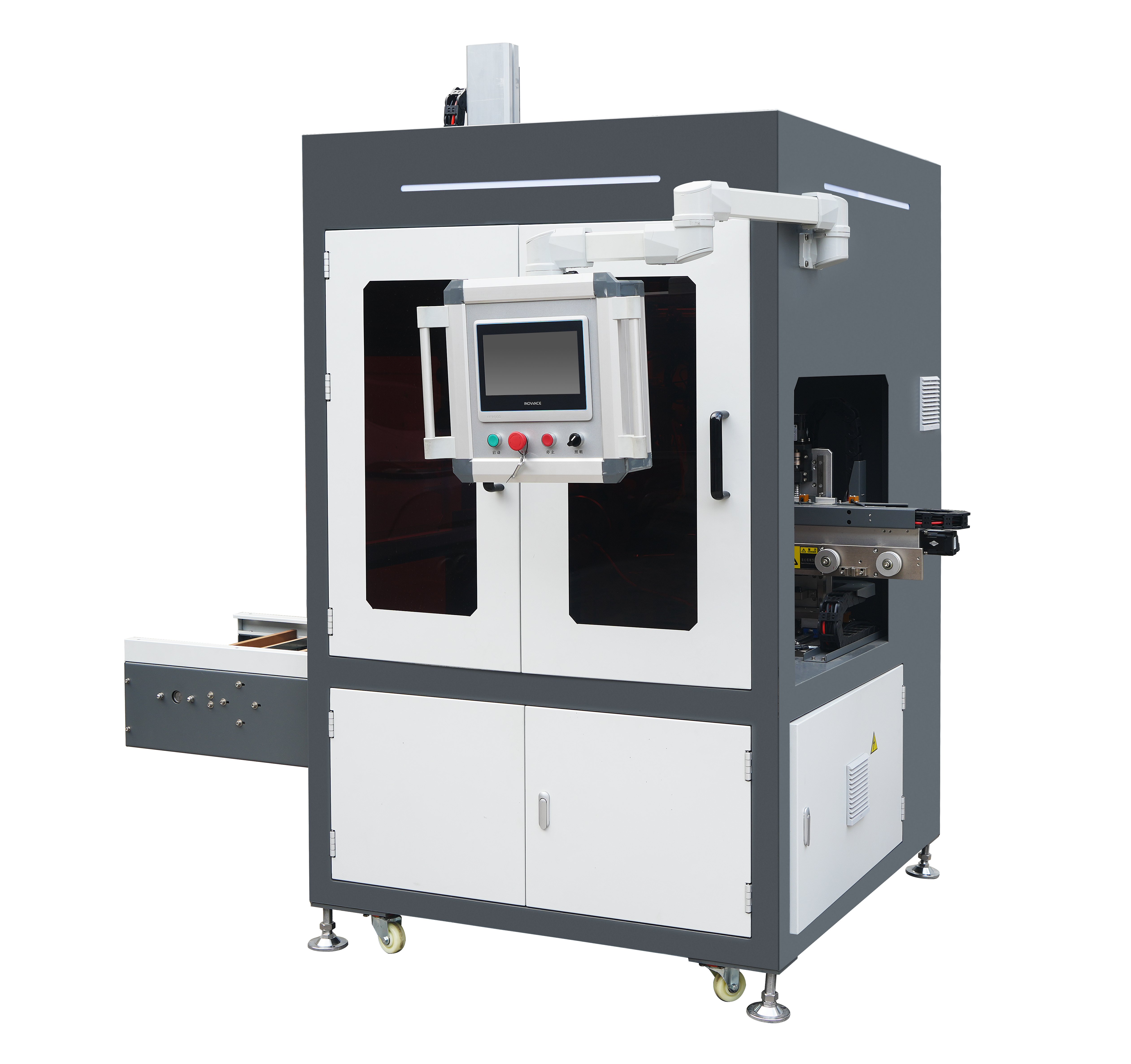
The winder takes the filament up at up to 200 m/min onto spools with a 52–56 mm core and up to 200 mm outside diameter, about 1 kg of filament per spool. At the start of each wind, an automatic glue station feeds, cuts and applies tape in one motion, fixing the filament end to the spool at an adjustable length and position so the first layers wind in order. A 1.5 kW vacuum pump holds the joint flat, and tape tension adapts to the filament so the surface is not damaged. Traverse runs on a servo screw or cam for a flat, even roll face. Seventeen Inovance servo axes (about 7.75 kW in total) drive roll change, and the machine stops itself on filament break detected by photoelectric and proximity sensors; a laser sensor handles precise hole threading. Fixed-length winding, output statistics and remote monitoring run continuously, so the line winds without an operator standing at the spool.
Automatic winding machine with the tape-fixing station.
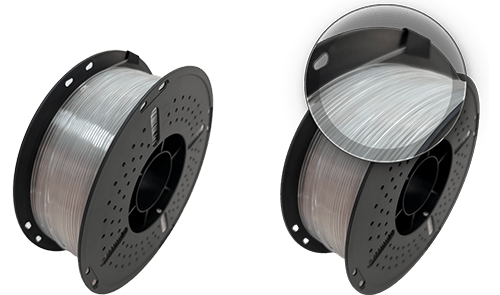
A finished filament spool from the tape-fixing winder.
Control and electrical safety
The line is operated from an Inovance 10-inch touch screen with an independent extruder PLC linked to the winder. The HMI stores temperature curves, manages recipes, runs fault diagnosis and logs output statistics. Communication uses RS485 and Ethernet with Modbus TCP/RTU, so the line can be integrated into an MES. Schneider breakers and contactors provide overload and short-circuit protection, and Taisong current-detection sensors monitor the temperature-control circuits in real time. The line runs on a three-phase 380 V / 50 Hz TN-S supply with a total installed power of 69.4 kW, including both hot-tank heating groups, rack traction and the hopper.
Electrical control cabinet.
Installation, training and support
The first on-site commissioning is free of charge and includes operator training.
The machine carries a one-year warranty under the company's warranty policy (electrical components replaced); maintenance support continues for the equipment's service life, with the exact scope and cost defined in the warranty policy.
Delivery is scheduled within 65 working days after the deposit.
Site preparation: a 1-inch water connection (one in, one out), 16 mm² five-core power with a 100 A leakage breaker (5–6 m), a 12 mm compressed-air line from the supply to the machine, a forklift and a hand cart; a 2 t crane if the line must be moved to an upper floor.
Frequently asked questions
Which materials can the RC-50 filament extrusion line process?
The RC-50 is designed to process materials such as PETG, ABS, PLA, PLA+, etc. for 3D printing filament production. Processing parameters should be adjusted according to the selected material grade and production requirements.
What filament diameter can the RC-50 produce?
The standard filament diameter is 1.75 mm. Other diameters may be evaluated for customization. Please confirm the required diameter before ordering.
What filament diameter tolerance can the line achieve?
The specified finished-filament diameter tolerance is ±0.03 mm under agreed operating conditions. Actual results depend on the material, process settings, and production conditions.
What is the maximum extrusion output of the RC-50?
The specified extrusion output is up to 37 kg/h, adjustable according to production requirements. Actual output depends on the material, filament diameter, and operating conditions.
What winding configuration is available for the RC-50?
The RC-50 is currently available with a tape-fixing winding configuration. Please confirm spool compatibility and end-fixing requirements with Rongcai before ordering.
What is the minimum order quantity and lead time?
The minimum order quantity is 1 unit. The stated lead time is within 65 working days after receipt of the deposit. The applicable delivery milestone and schedule should be confirmed in the order agreement.
Does Rongcai provide installation and warranty support?
Rongcai can arrange overseas on-site installation and commissioning. The buyer is responsible for applicable travel expenses, meals, accommodation, local transportation, and the engineer service fee of USD 120 per person per day for all billable days from departure until return. The machine has a one-year factory warranty, subject to applicable terms and exclusions.
Not Sure Which Filament Extrusion Line to Choose?
Compare the RC50 high-speed line with the RC45 standard-speed line to review their configurations and winding options.
Tell us your material, target output, spool specifications and installation requirements. Our team will review your production needs and discuss a suitable line configuration with you.
The RC-45 Standard-Speed 3D Filament Extrusion Line is a 3D printer filament production line for materials such as PLA, PLA+, PETG and ABS. It integrates extrusion, cooling, in-line diameter measurement, traction and automatic winding, with configuration options to match production targets, filament diameter and spool requirements.
Automatic Filament Winding Machine – Tape Fixing Type
Automatic winding station that spools finished filament under controlled tension and fixes the filament end to the spool with tape, so the spool leaves the line ready for packing without manual handling.
Automatic Filament Winding Machine – Threading Hole Type
Automatic winding station that spools finished filament under controlled tension and locks the filament head and tail through holes in the spool core, so the spool leaves the line secure and tape-free without manual handling.