Automatic Filament Winding Machine – Threading Hole Type
Automatic winding station that spools finished filament under controlled tension and locks the filament head and tail through holes in the spool core, so the spool leaves the line secure and tape-free without manual handling.
Head and tail both locked through spool holes — no manual gluing, binding or tail wrapping
Winds up to 120 m/min with ±0.1% line speed accuracy; servo screw / cam traverse keeps the roll face flat
Chaorong laser sensor gives precise hole threading alignment on the spool core
Inovance Easy PLC + 10-inch touchscreen with auto roll change, break stop, fixed length and data statistics
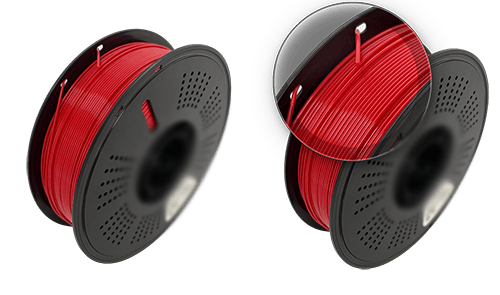
Threading hole; head and tail locked through front and rear spool holes
Applicable materials
PETG, ABS, PLA, PLA+, etc.
Applicable filament diameter
φ1.75 mm, tolerance ±0.03 mm
Winding speed
Up to 120 m/min, line speed accuracy ±0.1%
Production capacity
Matches extrusion lines with output up to 25 kg/h
Spool core ID
φ53–58 mm
Maximum winding OD
φ200 mm
Typical spool weight
Approx. 1 kg per spool
What this machine does on the line
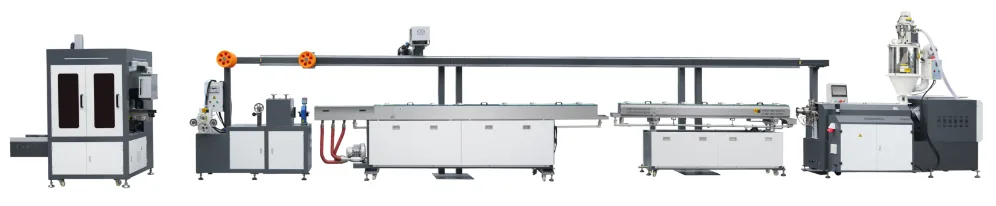
The Threading Hole Type automatic filament winding machine is the end-of-line station for 3D printing filament production. It takes filament off the extrusion line, winds it onto spools, and locks both ends of the filament through holes in the spool core, so every spool leaves the line neat, secure and ready for packing without any manual gluing or binding.
The threading-hole variant fixes the filament head and tail through punched holes and keeps a clean, tape-free spool surface. For plants whose spool format uses tape fixing, a tape-fixing variant is also available.
How the threading-hole fixing works
At the start of winding, the filament head is threaded into the positioning hole at the front of the spool and locked, so the winding start cannot slip, loosen or wander and the first layer lays neat and orderly.
When the set length is reached, the filament tail is automatically threaded into the reserved hole at the rear of the spool to finish the lock-in, preventing tail rebound, loose winding and detachment.
Head and tail are both fixed by threading holes — no manual gluing, binding or tail wrapping — across different filament specifications.
The finished roll is tight, regular and evenly arranged, with a uniform appearance, greatly reducing manual intervention.
Winding performance
Winding speed reaches up to 120 m/min with ±0.1% line speed accuracy. Traverse is handled by a servo screw / cam mechanism — precise displacement with rapid reversal keeps the roll face flat and even. The station pairs with extrusion lines up to 25 kg/h output, such as the standard-speed filament extrusion line, and winds φ1.75 mm filament with a ±0.03 mm tolerance.
Spool compatibility
Core inner diameter φ53–58 mm, maximum wound outer diameter φ200 mm, and approximately 1 kg of filament per spool — the machine is matched to the spool your plant packs.
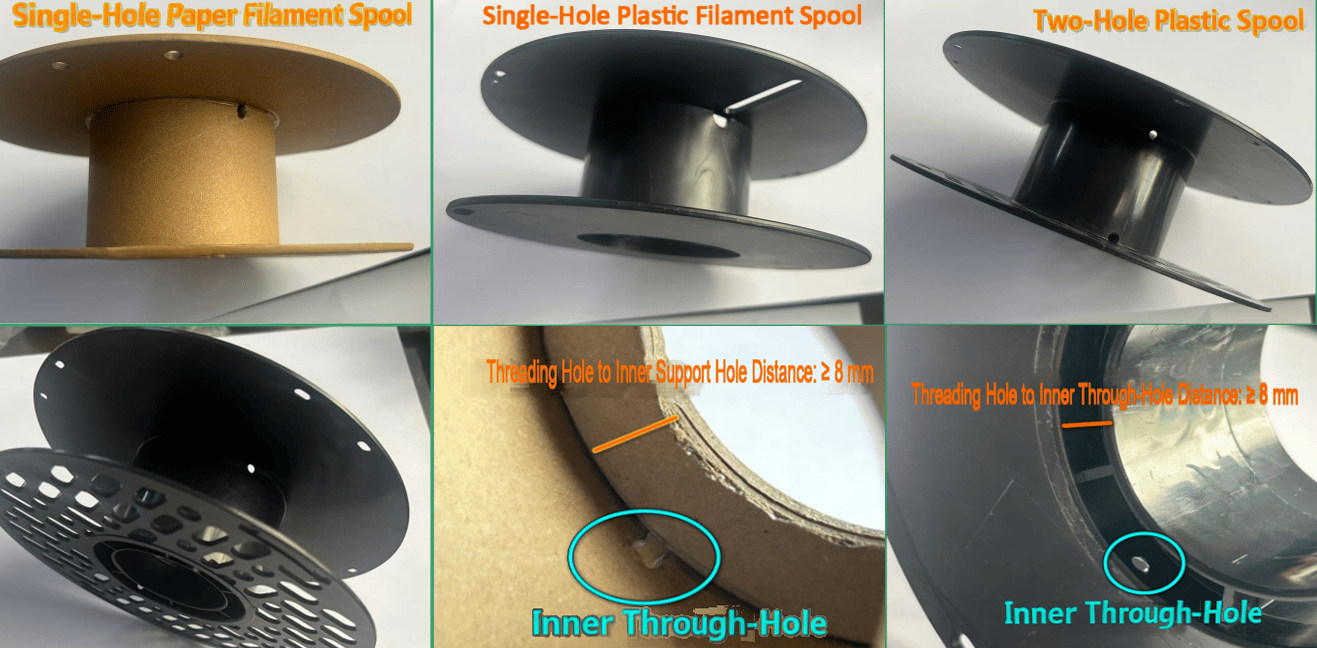
Suitable spool formats: single-hole paper and plastic spools and two-hole plastic spools, with a threading hole at least 8 mm from the inner support hole.
Spool requirements
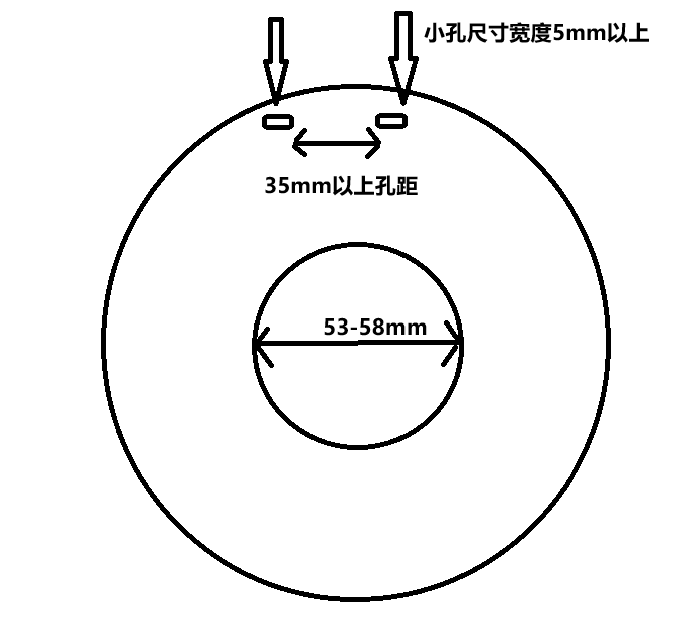
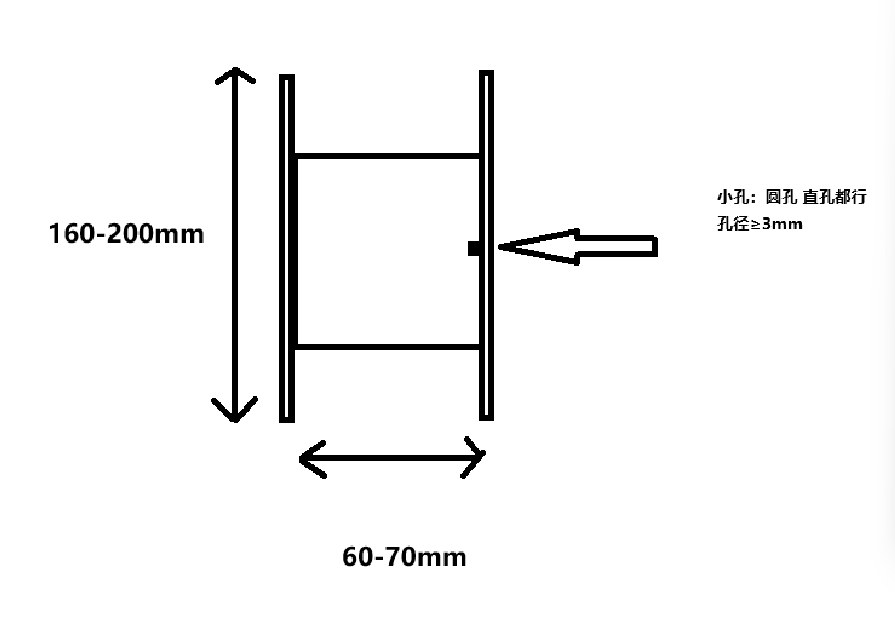
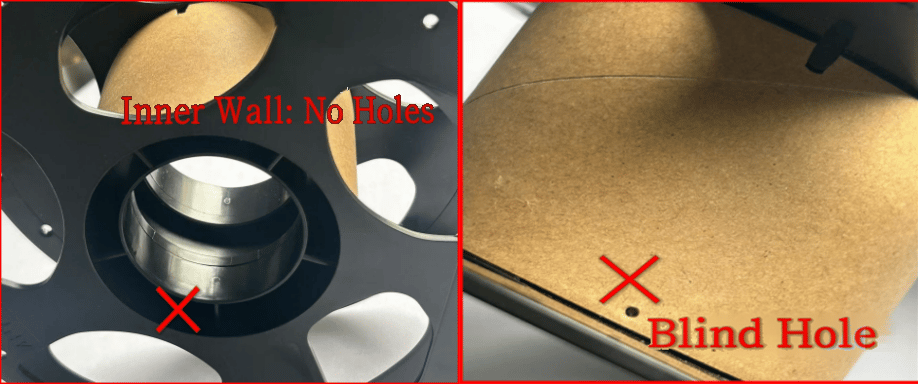
The threading-hole winder works with spools whose threading holes are at least 5 mm wide with a hole spacing of 35 mm or more, a core inner diameter of 53–58 mm, a spool width of 160–200 mm and a flange width of 60–70 mm. Both round holes and straight slots work: the documented requirement is a hole diameter of 3 mm or more and an opening width of 5 mm or more, and the hole must pass through the core wall with the inner through-hole at least 8 mm from the threading hole. Spools with an unbroken inner wall or only blind holes are not suitable for this winder.
Spool face: hole width ≥ 5 mm, hole spacing ≥ 35 mm, core inner diameter 53–58 mm.Spool side: width 160–200 mm, flange 60–70 mm, threading hole ≥ 3 mm (round or straight slot).
Not suitable: spools whose inner wall has no holes or whose holes are blind.A finished filament spool from the through-hole winder.
Automation, control and MES connection
14 Inovance servo drives with high-torque, synchronous control (approx. 6.55 kW in total).
Inovance Easy series PLC with a 10-inch touchscreen.
Automatic roll change, self-stop on material break, fixed-length winding, production data statistics and remote monitoring reduce manual handling and downtime between rolls.
RS485 and Ethernet with Modbus TCP/RTU — documented as MES-ready.
Detection covers Omron proximity switches, Leuze photoelectric sensors for material break and spool-full conditions, and a Chaorong laser sensor for precise hole threading alignment.
Installation requirements
Power is 3-phase TN-S 380 V / 50 Hz at 7.0 kW total, wired 3L + 1N + 1E with 4 mm² flexible copper, plus a 1 MPa compressed-air supply. Schneider air switches and contactors provide overload and short-circuit protection; the pneumatic components are AIRTAC cylinders and solenoid valves. The machine measures 2400 × 1200 × 2400 mm and weighs 1050 kg — plan layout and loading for both.
Technical parameters
Filament fixing method
Threading hole; head and tail locked through front and rear spool holes
Applicable materials
PETG, ABS, PLA, PLA+, etc.
Applicable filament diameter
φ1.75 mm, tolerance ±0.03 mm
Winding speed
Up to 120 m/min, line speed accuracy ±0.1%
Production capacity
Matches extrusion lines with output up to 25 kg/h
Spool core inner diameter
φ53–58 mm
Maximum winding outer diameter
φ200 mm
Typical spool weight
Approx. 1 kg per spool
Spool threading holes
Round or straight-slot holes, diameter ≥ 3 mm and opening width ≥ 5 mm, spacing ≥ 35 mm, through the core wall
Spool dimensions
Width 160–200 mm, flange 60–70 mm
Traverse
Servo screw / cam; precise displacement with rapid reversal
Automatic roll change, self-stop on material break, fixed-length winding, data statistics, remote monitoring; roll changeover without manual intervention
Communication interface
RS485 / Ethernet; Modbus TCP/RTU; MES-ready
Electrical protection
Schneider air switches and contactors (overload / short circuit)
Pneumatics
AIRTAC cylinders and solenoid valves; 1 MPa supply
Power supply
3-phase TN-S 380 V / 50 Hz, 7.0 kW total
Wiring
3L + 1N + 1E, 4 mm² flexible copper
Machine size
2400 × 1200 × 2400 mm
Machine weight
1050 kg
Spool changeover
Automatic roll change
Frequently asked questions
Threading hole or tape fixing — how do I choose?
Both automatic filament winding machines wind filament automatically; they differ in how the filament ends are secured. The threading-hole winding machine locks the head and tail through holes in the spool core and keeps a clean, tape-free spool surface. The tape fixing type pastes the end to the spool surface, which suits standard spools. Check your spool format and packing process, and confirm the choice with Rongcai during the project review.
Which materials and diameters does it handle?
PETG, ABS, PLA, PLA+, etc. filament at φ1.75 mm with a ±0.03 mm tolerance, as documented. The head and tail are fixed by threading holes, so the spool must meet the hole requirements above.
Can it connect to our MES?
Yes. The machine communicates over RS485 and Ethernet with Modbus TCP/RTU and is documented as MES-ready. Confirm the exact integration scope with Rongcai engineering.
How is the machine packed and shipped?
Packing standards and spare parts are supplied according to the agreed accessory list for the project, and Rongcai arranges shipment on the buyer's behalf with freight borne by the buyer. Confirm packing and shipping details for your destination when requesting a quotation.
What does commissioning and warranty cover?
The first on-site commissioning is free of charge and includes operator training. Equipment is covered by Rongcai's warranty policy: one year on electrical components (replacement) with lifetime maintenance. Delivery is scheduled within 65 working days from receipt of the deposit.
Inquire about this winding machine
Tell us your filament material and diameter, target output, spool specification, and site power and air conditions — these details help us review your requirement and prepare a suitable configuration.
The RC-50 High-Speed 3D Filament Extrusion Line is a fully servo-controlled 3D printer filament production line designed to process materials such as PETG, ABS, PLA and PLA+ pellets into wound filament spools. It combines a 30:1 single-screw extruder with in-line laser diameter measurement, servo traction and automatic winding to support integrated filament production with reduced manual spool handling.
The RC-45 Standard-Speed 3D Filament Extrusion Line is a 3D printer filament production line for materials such as PLA, PLA+, PETG and ABS. It integrates extrusion, cooling, in-line diameter measurement, traction and automatic winding, with configuration options to match production targets, filament diameter and spool requirements.