

Equipment selection guide
PLA and PLA+ are the most common materials run on a 3D printing filament line, but they are not the easiest to hold to tolerance. The polymer is hygroscopic, melt behavior is sensitive to moisture and temperature, and finished filament is judged against a diameter spec that leaves little room for drift. Choosing a PLA filament extruder therefore comes down to matching four or five measurable line characteristics to your production target — not to a generic “best machine” label.
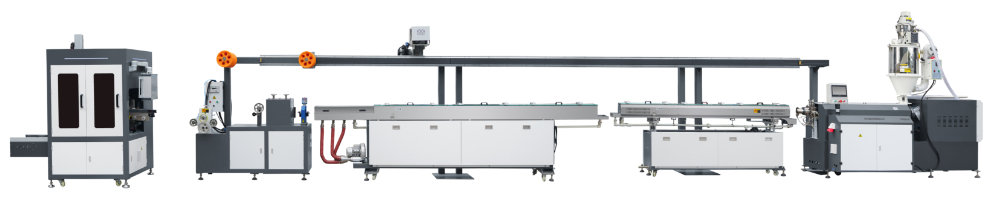
This article is about the equipment side: what PLA demands from an extrusion line, which specifications actually distinguish one machine from another, and how two Rongcai PLA extruder machine configurations — the RC-50 high-speed line and the RC-45 standard-speed line — fit different production plans. Process details (melt profile, spooling technique) are covered separately in the filament production guide.
Key takeaways
- Both Rongcai lines run PLA and PLA+ from pellets, with 1.75 mm filament as standard and other diameters available on evaluation.
- Compare candidate lines on output, traction/winding speed, diameter tolerance and in-line control, winding configuration, and drying arrangement.
- The RC-50 reaches up to 37 kg/h output and 200 m/min traction/winding speed; the RC-45 is rated to 25 kg/h and 120 m/min.
- Finished-filament tolerance is φ1.75 mm ±0.03 mm under agreed operating conditions; the inline laser gauge’s ±0.001 mm figure is its measurement accuracy, not the product tolerance.
What PLA actually demands from an extrusion line
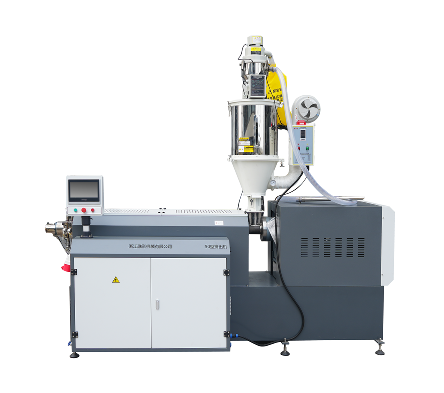
Two properties shape the equipment decision more than any other. The first is moisture. PLA absorbs water from ambient air, and feeding undried pellets into the extruder affects melt quality and the consistency of the finished strand. A line intended for PLA needs an integrated drying and feeding arrangement — Rongcai supplies both lines with dryer/loader feeding; the RC-45 includes a hot-air dryer adjustable from 40 °C to 100 °C. The drying schedule itself should be set for your specific resin and confirmed with the material supplier; the equipment requirement is simply that the line gives you controlled, adjustable drying ahead of the screw.
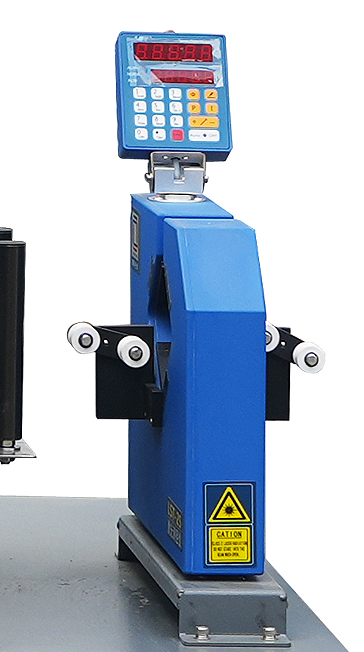
The second is diameter consistency. A 3D printer expects filament within a tight band, so the line must measure diameter continuously and correct it. Both Rongcai lines use an in-line dual-axis laser diameter gauge that measures the X and Y axes simultaneously, with ±0.001 mm measurement accuracy, an out-of-tolerance alarm, and automatic feedback to line speed. That last point matters: the gauge does not merely report — it closes the loop by adjusting traction speed, which is the practical mechanism for holding diameter on a running line.
Be careful with the numbers here, because suppliers sometimes blur them. The gauge’s ±0.001 mm is measurement accuracy. The finished filament specification is φ1.75 mm ±0.03 mm under agreed operating conditions. They are different metrics, and only the second one describes what comes off the winder.
Decision criteria: what to compare between candidate lines
1. Output target versus traction speed
Output (kg/h) tells you how much material the screw and die can process. Traction/winding speed (m/min) tells you how fast the finished filament can be pulled and wound. They are related but not the same, and maximum traction speed is not the same as stable production output — actual output depends on material, filament diameter and operating conditions. Use the output figure for capacity planning and the speed figure for line capability, then confirm the realistic combination for your material with the supplier.
2. Screw and drive configuration
Screw diameter, L/D ratio and drive type set the melting behavior and the stability of the line. Both Rongcai lines use a 30:1 L/D nitrided single screw and six independently controlled PID heating zones at ±3 °C. The difference is scale: the RC-50 uses a 50-type screw up to 200 r/min with a 17.3 kW main drive; the RC-45 uses a 45-type screw up to 120 r/min with an 11 kW permanent-magnet synchronous main drive.
3. Diameter tolerance and in-line control
This is where PLA production is won or lost. A line without closed-loop diameter feedback leaves the operator chasing drift. Both lines here include the dual-axis gauge with feedback to line speed, so the comparison is not “gauge versus no gauge” but whether the control loop is fast enough for your target output and tolerance band.
4. Winding configuration and spool compatibility
Winding is easy to overlook until spools start slipping or the filament end fails to hold. The RC-50 is currently available with a tape-fixing winding configuration only; confirm spool compatibility before ordering. The RC-45 is available in both tape-fixing and threading-hole configurations. The threading-hole option works with spools that have a core ID of φ53–58 mm, hole width ≥5 mm and hole spacing ≥35 mm. If your downstream market uses a particular spool, match the winder option to it at the specification stage.
5. Drying and material handling
As above, PLA needs drying before extrusion. Beyond the dryer itself, look at how the line handles the material path: the RC-45 includes a heating water tank group (4 m) and a cooling water tank group (4 m) with gradient pre-cooling, customizable, plus a storage rack that buffers approximately 330 m of filament. These details affect how smoothly the line runs between winding changes.
Two Rongcai lines, two production targets
The comparison below uses the published specifications for each line. Both run PLA and PLA+ (as well as PETG and ABS) from pellets, with 1.75 mm filament as standard; other diameters can be evaluated for customization and should be confirmed before ordering.
| Specification | RC-50 high-speed line | RC-45 standard-speed line |
|---|---|---|
| Extrusion output | ≤37 kg/h, adjustable | ≤25 kg/h, adjustable |
| Traction/winding speed | ≤200 m/min, ±0.1% speed accuracy | ≤120 m/min, ±0.1% speed accuracy |
| Screw | 50-type single screw, 30:1 L/D, nitrided | 45-type single screw, 30:1 L/D, nitrided |
| Heating zones | 6 independent PID zones, ±3 °C | 6 independent PID zones, ±3 °C |
| Screw speed | Up to 200 r/min | Up to 120 r/min |
| Main drive | 17.3 kW | 11 kW permanent-magnet synchronous |
| Diameter control | Dual-axis laser gauge, ±0.001 mm measurement accuracy, alarm and feedback to line speed | Same dual-axis laser gauge configuration |
| Winding | 17 Inovance servo axes; spool core φ52–56 mm, OD ≤φ200 mm, ~1 kg/spool; tape-fixing configuration only (confirm spool compatibility) | Tape-fixing and threading-hole configurations; threading-hole for spools with core ID φ53–58 mm, hole width ≥5 mm, hole spacing ≥35 mm |
| Drying | Dryer/loader feeding included | Hot-air dryer 40–100 °C adjustable; dryer/loader feeding included |
| Other line elements | — | Heating water tank group (4 m) + cooling water tank group (4 m), gradient pre-cooling, customizable; storage rack buffers ~330 m |
| Installed power | 69.4 kW | 69 kW |
| Footprint / weight (extruder unit) | 2,600 × 940 × 2,800 mm, ~690 kg | — |
When the RC-50 fits
If your production plan centers on higher throughput per line and your winding setup can work with the tape-fixing configuration, the RC-50 high-speed filament extrusion line is the higher-capability option. The 50-type screw, 17.3 kW drive and 200 m/min traction/winding ceiling give it more headroom, and the 17-servo-axis winder is built for consistent spool building at speed. The trade-off is narrower winding flexibility: tape-fixing only, so spool compatibility must be settled before order.
When the RC-45 fits
If your target is moderate output with broader spool and winding flexibility, the RC-45 standard-speed filament extrusion line is the more adaptable configuration. It offers both tape-fixing and threading-hole winding, an integrated adjustable hot-air dryer, and the gradient pre-cooling and buffering arrangement that helps a line run steadily. Its 25 kg/h output and 120 m/min traction/winding speed suit production plans that do not need the RC-50’s upper range.
How to specify a PLA extruder machine before you compare quotes
A useful request for quotation states the requirement, not just the material. Before approaching suppliers, define:
- Output target in kg/h, and whether that is a planning figure or a contractual one.
- Filament diameter — 1.75 mm is standard; other diameters should be flagged for evaluation and confirmed.
- Tolerance expectation against the φ1.75 mm ±0.03 mm specification and the operating conditions under which it applies.
- Spool type you will sell on, including core ID and hole geometry if you need threading-hole winding.
- Drying arrangement and the resin you will run, so the dryer specification matches your material.
With those defined, the RC-50 vs RC-45 decision usually resolves on two points: whether you need the higher output/speed ceiling, and whether your spools require threading-hole winding.
Supplier and commercial considerations
Rongcai manufactures 3D printing filament extrusion lines and automatic winding machines from its 48,000 m² operating production base in Wenzhou (Pingyang), with a 65,000 m² base under construction in Anji (Huzhou), expected to start production in 2027, and a nearly 4,000 m² independent R&D base. Commercial terms for either line: MOQ 1 unit; lead time within 65 working days after deposit; first on-site commissioning free, including operator training; one-year factory warranty (terms and exclusions apply); overseas installation available with the buyer covering engineer service fees of USD 120/person/day plus travel costs.
For a shortlist decision, request the line specification against your stated output, spool and diameter requirements, and ask how the diameter control loop is set up for your material. You can reference the product pages above or use the site inquiry form to start that conversation.
FAQ
Can one line run PLA and other materials?
Yes. Both the RC-50 and RC-45 run PLA and PLA+ as well as PETG and ABS from pellets. Settings for each material differ, and the drying arrangement should match the resin you run.
What filament diameter is standard, and can I order another size?
1.75 mm is standard on both lines. Other diameters can be evaluated for customization; confirm the requirement with the supplier before ordering.
Is the ±0.001 mm figure the filament tolerance?
No. ±0.001 mm is the measurement accuracy of the in-line dual-axis laser gauge. The finished-filament diameter specification is φ1.75 mm ±0.03 mm under agreed operating conditions.
Which winding configuration do I need?
It depends on your spools. The RC-50 is currently offered with tape-fixing winding only — confirm spool compatibility before ordering. The RC-45 offers both tape-fixing and threading-hole winding; threading-hole suits spools with core ID φ53–58 mm, hole width ≥5 mm and hole spacing ≥35 mm.