
RC-50 High-Speed 3D Filament Extrusion Line
Fully servo-controlled line for higher output per hour, combining a 30:1 single-screw extruder with in-line laser diameter measurement, servo traction and automatic winding.
Turning polymer pellets into consistently round, tightly wound filament spools takes more than an extruder. This guide walks through the complete 3D filament production process, explains the equipment each stage requires, and shows you how to choose a filament extrusion line that matches your material, output target and spool specification.
3D printer filament production is a continuous process: melt the polymer, form it into a strand, cool it to size, measure it, and wind it onto a spool without stopping. Each stage affects the next, which is why production lines are specified as a whole rather than as isolated machines.
Filament starts as polymer pellets — commonly PLA, PLA+, PETG or ABS. Because these polymers absorb moisture, pellets are dried before extrusion; trapped moisture otherwise causes bubbles, surface defects and inconsistent diameter.
A single-screw extruder melts and pressurizes the polymer, and the die at the end of the barrel forms the melt into a continuous strand. Stable melt temperature and pressure are what keep the strand round and uniform as it leaves the die.
The strand passes through a cooling bath, where it solidifies and is sized toward its final diameter. Cooling length and temperature control determine how completely the filament is set before measurement. For a deeper look at this stage, read Cooling and Sizing in Filament Extrusion: Why the Water Bath Decides the Tolerance.
A laser diameter gauge measures the strand continuously. The measurement feeds back to the traction unit so line speed is corrected in real time — this closed loop is what keeps filament diameter consistent over a full spool, spool after spool. See Filament Diameter Control: How In-Line Measurement and Traction Hold Tolerance for how the loop works in practice.
A servo traction unit pulls the filament at a controlled speed, and the automatic winding machine spools it under controlled tension and fixes the filament end. The finished spool then leaves the line ready for packing.
For a plain-language walkthrough of each step, read our guide: How 3D Printing Filament Is Made: The Extrusion Process Explained.
A complete 3D printer filament production line chains five equipment groups together. Understanding what each one does makes line selection much easier.
The extruder melts the pellets and pushes the melt through the die at a stable rate. Screw design and melt control determine how well the line handles your polymer.
A water bath solidifies and sizes the strand. Its length and temperature control must match your line speed and material, or the filament reaches measurement still too soft.
Measures filament diameter continuously and reports deviations before they become a full spool of out-of-spec product.
Pulls the filament at a precisely controlled speed; it is the actuator that diameter feedback corrects.
Spools finished filament under controlled tension and fixes the filament end so spools are ready for packing without manual handling. Winding is a subject of its own — see our 3D Printer Filament Winding Guide.
Browse all equipment groups on one page: 3D printing filament extrusion lines.
The right line is the one matched to your material and your production target — not simply the fastest or the cheapest. Work through these five dimensions before requesting a quotation.
Confirm which polymers you will run — PLA, PLA+, PETG, ABS or others — and whether you need to switch materials. Screw, die and drying configuration should be matched to your material list.
Estimate the output you actually need per shift, in kilograms of wound spools. This decides whether a standard-speed or high-speed configuration fits.
Most spool buyers produce 1.75 mm or 2.85 mm filament. What matters for quality is how the line controls diameter: inline laser measurement with feedback to traction keeps diameter consistent without operator intervention. Confirm tolerance targets for your specific configuration on the product pages.
Fully servo-controlled lines coordinate extrusion, measurement, traction and winding automatically; more manual setups cost less but depend more on operator attention.
Cooling length, and whether winding is tape-fixing or threading-hole type, should match your material and spool specification.
For a deeper walkthrough, read: How to Choose a 3D Printing Filament Extrusion Line. Side-by-side decision help: compare high-speed and standard-speed extrusion lines.
Both configurations produce the same thing — wound spools of consistent filament. The difference is throughput and automation.
The RC-50 High-Speed 3D Filament Extrusion Line is a fully servo-controlled line designed for higher output per hour, combining a 30:1 single-screw extruder with in-line laser diameter measurement, servo traction and automatic winding. It suits producers whose target output justifies the higher investment.
The RC-45 Standard-Speed 3D Filament Extrusion Line integrates extrusion, cooling, in-line diameter measurement, traction and automatic winding, with configuration options to match production targets and filament materials. It suits standard output targets and a more moderate investment level.
If you are deciding between the two, start with the compare page: High-Speed vs Standard Filament Extrusion Line | Compare.
Detailed specifications, including cooling and winding configurations, are maintained on each product page:
Fully servo-controlled line for higher output per hour, combining a 30:1 single-screw extruder with in-line laser diameter measurement, servo traction and automatic winding.
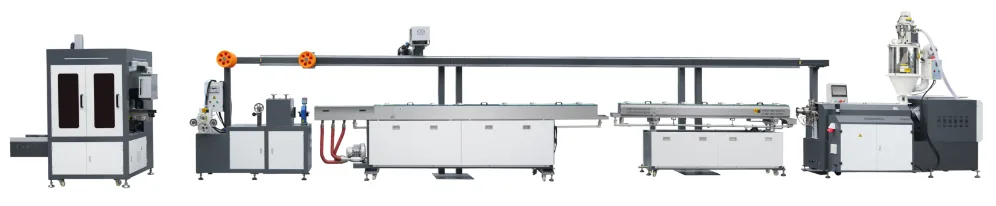
Integrates extrusion, cooling, in-line diameter measurement, traction and automatic winding, with configuration options to match production targets and filament materials.
When buyers compare lines on paper, output looks like a single number. In practice, actual output depends on several interacting factors:
Because these factors interact, we do not quote a one-size-fits-all output figure. Share your material and target diameter and we will discuss the configuration that reaches your target: contact Rongcai about your production requirements.
The current RC-50 and RC-45 lines process common spooling polymers supplied as pellets, such as PLA, PLA+, PETG and ABS. Suitability for a specific polymer or additive depends on the screw, die and drying configuration, so tell us your material and we will confirm the matching setup. See the RC-50 and RC-45 product pages for the configurations documented there.
An inline laser diameter gauge measures the filament continuously and feeds corrections back to the traction unit, keeping diameter consistent without stopping the line. Diameter tolerance targets are confirmed per line configuration — see the product pages rather than assuming a universal figure.
Your filament material, target output, filament diameter, spool specification and destination. With these five items we can propose a concrete line configuration: Request a Quote. For the complete checklist, see Information a Filament Extrusion Line Quotation Needs.
Yes — confirmed MOQ, delivery, installation and warranty terms are summarized on our Installation, Delivery & Warranty page.
Yes. Rongcai automatic winding machines work as standalone stations and can also be matched to an extrusion line. See the 3D Printer Filament Winding Guide and the automatic filament winding machines category for the two fixing types.
Tell us your material, target output, filament diameter and spool requirements, and our engineers will reply with a line configuration and quotation.