Filament Diameter Control: How In-Line Measurement and Traction Hold Tolerance
Diameter is held by a loop rather than by the extruder: the gauge measures, the controller compares, and the traction drive corrects. This guide explains what each part contributes to tolerance and which two questions to ask about any figure on a datasheet.
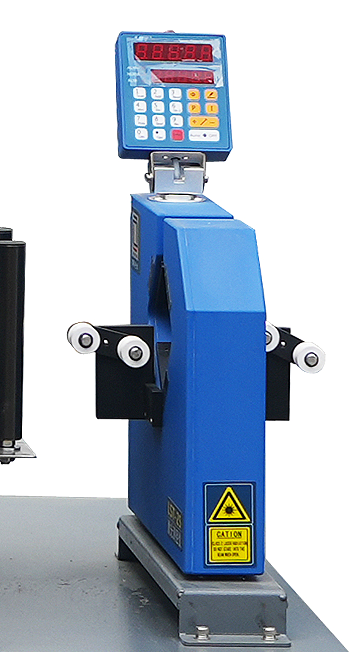
Filament diameter is not held by the extruder alone. It is held by a control loop: a gauge measures the strand, the controller compares that reading with the target, and the traction drive changes speed to bring the strand back. If any of those three parts is weak, the tolerance band on the spool widens even when the extruder itself is running steadily.
Why the diameter drifts in the first place
Three things move the diameter during a run:
- Melt output changes. Screw speed, feed consistency and barrel temperature all affect how much polymer leaves the die per second.
- Pull-off speed changes. The strand is drawn down as it is pulled. A faster pull makes a thinner strand.
- Cooling changes. If the strand is not fully set when it reaches the pull-off, the final diameter depends on how it solidified rather than on what left the die.
What in-line measurement actually provides
A laser gauge reads the strand many times per second while it is still moving, so the measurement covers the whole run instead of a sample cut from the end of a spool. That matters because a spool can pass a spot check and still contain a section that drifted. The gauge produces two useful outputs: the current diameter, and the record of how far the diameter moved during the run.
Measurement only helps if the correction is fast
| Element | What it contributes to tolerance |
|---|---|
| Gauge resolution and sampling rate | How small a deviation can be seen, and how quickly it is seen |
| Servo traction | How quickly the pull-off speed can be corrected without a speed ripple |
| Controller logic | Whether the correction is applied to traction, to screw speed, or to both, and whether it over-corrects |
| Cooling stability | Whether the strand arriving at the gauge is already set, so the reading means something |
A precise gauge on a line with a mechanically driven pull-off gives you an accurate record of a problem you cannot correct. That is why measurement accuracy and drive precision belong in the same specification.
How this loop is documented on the current lines
On Rongcai's two extrusion lines, the diameter control loop is documented end to end, which is what makes the specification checkable rather than a set of separate numbers:
| Loop element | Documented specification |
|---|---|
| Diameter gauge | Dual-axis laser gauge measuring the X and Y axes simultaneously at ±0.001 mm, monitoring roundness and ellipticity in real time |
| Correction action | Out-of-tolerance filament triggers an alarm and automatic feedback to line speed |
| Traction | Servo-driven double- or triple-roll clamping with ±0.1% speed accuracy, synchronized with winding |
| Line speed | Up to 200 m/min on the RC-50 high-speed line; up to 120 m/min on the RC-45 standard-speed line |
| Finished tolerance | φ1.75 mm filament at ±0.03 mm under agreed operating conditions |
The full documented specification of each line is on the RC-50 high-speed filament extrusion line and RC-45 standard-speed filament extrusion line product pages, and the filament extrusion line comparison page sets the two side by side. The cooling side of the same loop — why the strand has to be set before the reading means something — is covered in the cooling and sizing guide.
Reading the numbers on a datasheet
Tolerance figures are usually written against a diameter, for example the nominal diameter plus or minus a band. Two questions are worth asking about any figure you are given:
- Is the band a measurement resolution or a guaranteed spool tolerance? They are different claims and are not interchangeable. A ±0.001 mm gauge accuracy is not a ±0.001 mm filament tolerance.
- Is the figure quoted for one material, or across all the materials you run? PETG, PLA and PLA+ do not cool at the same rate, so tolerance can differ between them on the same line.
What to confirm about the loop before ordering
- How many axes the gauge measures and at what accuracy, and whether roundness and ellipticity are monitored.
- What the out-of-tolerance reaction actually is: an alarm only, or automatic feedback to line speed.
- Which element the correction acts on — traction, screw speed, or both — and how over-correction is avoided.
- Whether the quoted speed is a maximum rated value or the expected operating speed for your material and tolerance band.
- How the finished spool is inspected, so a bench measurement can be compared against the in-line record.
Frequently asked questions
Does the line need a gauge if the extruder is stable?
A stable extruder reduces the size of the drift but does not remove it, because cooling and pull-off conditions still vary during a run. Without a gauge the operator corrects by sampling finished filament, which is slower and cannot catch a short drift inside a spool.
Should the controller adjust screw speed or traction speed?
Both are possible. Adjusting traction speed changes the diameter quickly but also changes line speed. Adjusting screw speed changes output more slowly but keeps the pull-off constant. The controller setting is chosen per line configuration and material.
How is diameter checked on the finished spool?
In-line measurement records the run; a bench measurement on a finished spool is a check of that record and of handling after winding. Keeping both lets you separate a process drift from a measurement or handling issue.
Next step
If diameter tolerance is the deciding factor for your line, tell us the diameter and band you must hold, the material, and how the finished spool is inspected. Request a quote and we will confirm the configuration that covers it.