Cooling and Sizing in Filament Extrusion: Why the Water Bath Decides the Tolerance
The strand is still soft when it leaves the die, so the cooling section is what settles its final shape. This guide covers the reason for a warm bath ahead of the cold bath, the three settings that decide the outcome, and where to look first when ovality or start-of-run drift appears.
Between the die and the pull-off, the filament is still deciding what shape it will keep. Cooling and sizing is the stage that settles that shape, and it is also the stage that most often explains a diameter that drifts only at the start of a run or only on thicker sections of the strand.
What happens as the strand leaves the die
What exits the die is a soft, hot strand. It has the die's cross section but not yet the die's final dimensions, because the strand is still being stretched by the pull-off and is still shrinking as it cools. The purpose of the cooling section is to remove that stretch and shrink from the equation by solidifying the outer surface early and the core progressively.
Why many lines use a hot bath before the cold bath
A single cold bath makes the outside of the strand set fast while the inside is still soft. The skin then holds a shape that the core later pulls against, which shows up as ovality and as internal stress locked into the spooled filament. Running the strand through warm water first slows the first stage of cooling so the temperature gradient is gentler, and the cold bath then finishes the process. The result is a rounder strand and a spool that flattens less at the edges.
Three settings that decide the outcome
- Water temperature in each tank. Warmer first-stage water gives a gentler gradient; colder second-stage water sets the strand before it reaches the pull-off.
- Distance from the die to the water surface. This short air gap is where initial draw-down happens. Making it longer increases draw-down; making it shorter reduces it but risks marking the strand.
- Contact length and support. How long the strand runs in the bath and how it is guided across the bath decides whether the strand stays straight or sags between supports.
What a documented cooling section looks like
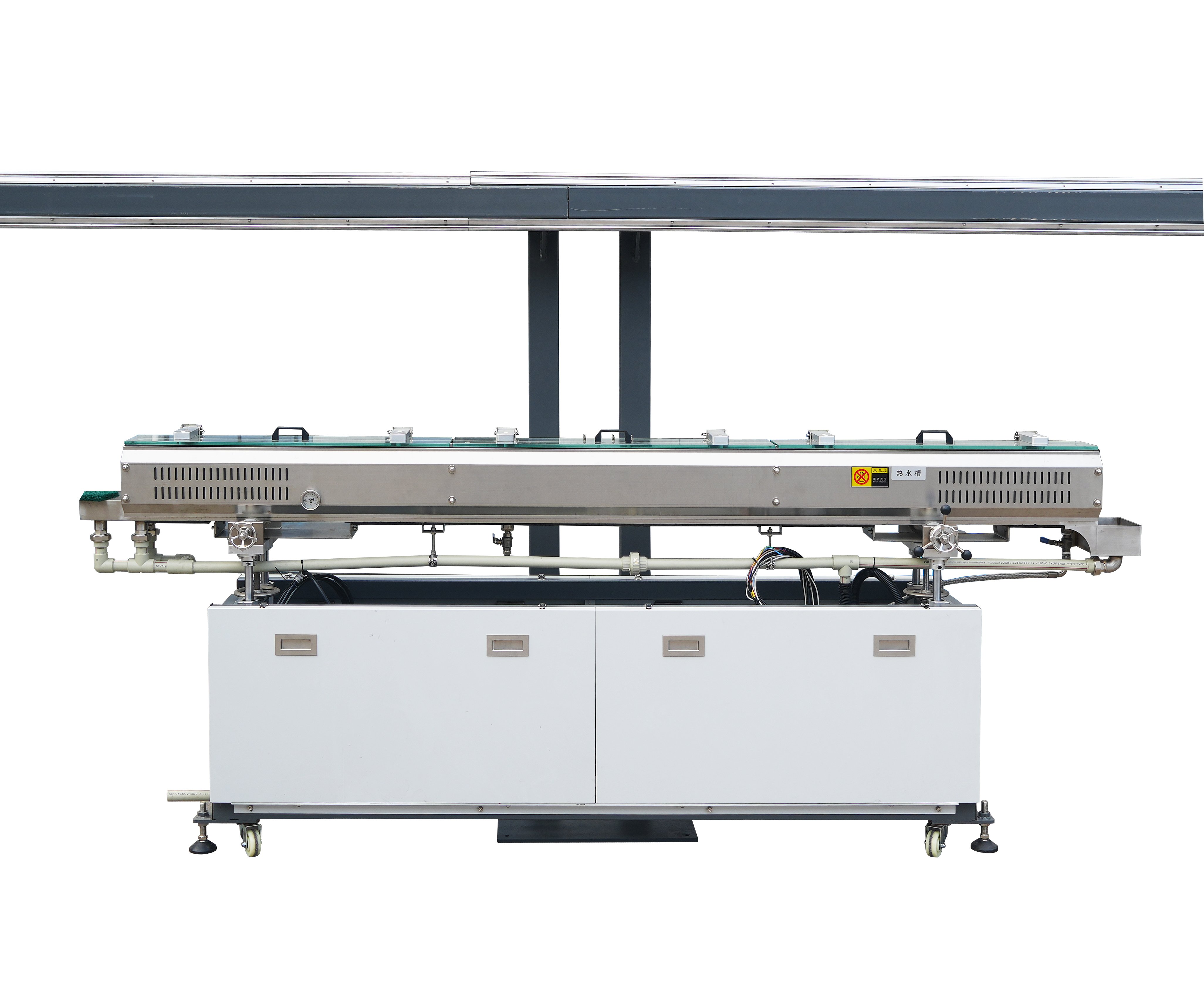
On Rongcai's current lines, the cooling and sizing stage is built as a gradient pre-cooling section: the melt passes a heating water tank group ahead of the cooling water tank, so internal stress is relieved before main cooling. The documented details are worth knowing when you compare lines, because they show how much of the cooling behaviour is actually controlled rather than left to ambient conditions.
| Cooling section detail | Documented on the current lines |
|---|---|
| Bath arrangement | Hot-water tank group ahead of the cold-water tank; the RC-45 standard arrangement is 3+3+6 tanks and can be customized per process, layout and material |
| Hot-water temperature | Continuously adjustable from 30 to 90 °C at ±3 °C, so each bath can sit near the transition range of the material being run |
| Tank heating | Three 2 kW stainless-steel heating elements per tank; set point reached in about 15 minutes |
| Bath circulation | Internal circulation pump of 0.5–2 m³/h with filtration, keeping the bath even and protecting the filament surface |
| Water management | Automatic make-up, level control and drainage, with water-shortage, over-temperature and leakage protection |
| Cold tank | Cooled through an external chilled-water connection; the RC-50's main cold tank runs 6,000 mm long |
Both the RC-50 high-speed filament extrusion line and the RC-45 standard-speed filament extrusion line carry their full tank configuration and specification on the product pages, and the line comparison page sets the two side by side.
Symptoms and where to look first
- Oval cross section. Check the balance between the first and second bath, and whether the strand is being pulled while still soft.
- Diameter correct at start of run, drifting later. Usually a cooling or tank-temperature change rather than the extruder, because the extruder settled first.
- Rough or marked surface. Often the air gap is too short, or the strand is contacting a guide while still soft.
- Spool with soft or flattened edges. Frequently a tension and winding question rather than cooling, so check the winding side before changing cooling settings.
Cooling details to confirm before ordering a line
- Number, length and arrangement of the hot and cold tanks for your material and floor plan.
- Hot-water temperature range and control accuracy, and how each bath is held at its set point.
- Where the chilled water for the cold tank comes from: the plant supplies the water connection, and the cold tank regulates through an external chilled-water link.
- Circulation and filtration of each bath, and the protection functions (water shortage, over-temperature, leakage).
- Whether the tank arrangement needs customizing for a second material or a different layout.
Frequently asked questions
Is the cooling section different for PETG, PLA and PLA+?
Yes. The three materials differ in how quickly they set and in how much internal stress they hold, so bath temperatures and line speed are tuned per material. A setting that produces good filament on one material is not automatically correct for another.
Can cooling fix a diameter problem that starts at the extruder?
No. Cooling sets the shape of the strand that the extruder produced. If melt output is unstable, cooling will not remove that instability; it only prevents cooling from adding a second one. Diagnose melt output and cooling conditions separately. The measurement and traction side of the loop is covered in the filament diameter control guide.
Does a longer bath always give better filament?
No. Bath length has to match line speed and material. A bath that is too long for the speed can over-cool the strand relative to the draw-down the line needs, and it takes up floor space the layout may not have.
Next step
If ovality or start-of-run diameter drift is the problem you are trying to solve, tell us the material, the diameter and the line speed you run. Request a quote or send us the requirement and we will confirm the cooling and sizing configuration that fits it.